Every evaporative cooling system reaches a point where a repair starts to feel like a temporary fix rather than a proper solution. Homeowners searching for Evaporative Air Conditioning Perth replacement options are usually at exactly this stage, trying to work out whether it’s worth pouring more money into an ageing unit or better to start fresh.
This guide walks through typical lifespans, when a repair still makes sense, when replacement becomes the smarter option, and the warning signs that suggest a system is on its way out.
How Long Does Evaporative Cooling Last?
Most evaporative cooling systems last somewhere between 10 and 15 years with reasonable care and regular servicing. Some well-maintained units can run longer, while systems that have gone years without servicing often start showing serious wear well before that range.
Lifespan depends heavily on how consistently the system has been serviced, the quality of the original components, and how much use it’s had each summer.
How Many Years Should an Evaporative Cooler Last?
As a general benchmark, 10 to 15 years is a realistic expectation for a residential evaporative cooling system. Premium brands built with more durable components can sometimes push toward the higher end of that range, or slightly beyond it, provided servicing has been kept up throughout.
A system that’s failing well before the 10-year mark is often a sign of inadequate servicing history, lower-quality components, or a system that was undersized for the home from the start.
When Should You Replace One?
Replacement generally makes sense once a system is old enough that multiple components are wearing out around the same time, repair costs start climbing toward a significant portion of a new system’s price, or the unit simply can’t keep the home comfortable anymore despite repairs.
It’s also worth considering replacement if the system is inefficient compared with newer models, since a more efficient unit can bring running costs down noticeably even before factoring in reduced repair bills.
When Is Repairing It Still Worthwhile?
Repairing still makes sense when the fault is isolated to a single component, the system is otherwise in reasonable condition for its age, and the repair cost is modest compared with the cost of a full replacement. A pump replacement or pad clean on an otherwise well-maintained 6 or 7-year-old system, for example, is generally a straightforward and worthwhile repair.
The key question is usually whether the repair addresses the actual problem or just delays a bigger issue that’s likely to surface again soon after.
Is a 10-Year-Old System Worth Repairing?
Often, yes, particularly if the system has been serviced regularly and the fault is a single component like a pump, motor, or set of cooling pads. At this age, a repair can still be a sensible option, especially if it’s the first significant fault the system has had.
That said, it’s worth weighing up the repair cost against how many more years of reliable service you’re likely to get, since a 10-year-old system is approaching the point where other components may not be far behind.
What About a 15-Year-Old System?
At 15 years, a system is generally at or beyond typical lifespan, and repair decisions become more about diminishing returns. Even a straightforward, inexpensive repair can be followed by a different fault within a year or two, since multiple components are wearing out around the same time.
At this age, replacement is usually the more sensible long-term option, particularly if the system has already had one or two repairs in recent years.
How Much Do Common Repairs Cost?
Common evaporative cooling repairs in Perth generally fall somewhere between $150 and $500, depending on the part involved. Pad replacements and minor pump issues sit toward the lower end, while motor replacements, more involved electrical faults, or larger parts tend to sit higher in that range.
Getting a clear quote before committing to a repair makes it easier to weigh the cost against the alternative of putting that money toward a new system instead.
When Does Replacement Become Cheaper?
Replacement generally becomes the more cost-effective option once repair costs start approaching 30 to 50 percent of the cost of a new system, particularly on a unit already past the 10-year mark. At that point, you’re often paying a substantial amount to extend the life of a system that’s still likely to need further repairs before long.
It’s also worth factoring in running costs. An older, less efficient system can cost more to run than a new one, which narrows the cost gap between repairing and replacing over time.
Can Existing Ducts Be Reused?
In many cases, yes, provided the ductwork is still in good condition and sized appropriately for the new unit. Reusing existing ducts can bring the overall replacement cost down noticeably, since ductwork and outlet fitting make up a meaningful portion of a full installation.
That said, ductwork that’s old, damaged, undersized, or poorly configured for a new unit may need some rework to get the best performance out of a replacement system. This is something worth checking during a site assessment before assuming ducts can simply be reused as-is.
Can the Existing Vents Remain?
Often, yes, as long as they’re in good condition and positioned appropriately for the new system’s airflow requirements. Existing outlets and vents are commonly kept in place during a replacement, which helps keep costs down compared with a completely new installation.
If the new unit has different airflow requirements or the home’s layout has changed since the original install, some outlets may need adjusting or adding, but a full outlet overhaul usually isn’t necessary just because the unit itself is being replaced.
Should I Replace It With Another Evaporative System?
For most Perth homes, yes, evaporative cooling remains a sensible replacement choice, particularly given Perth’s dry summer climate, where evaporative systems perform well and cost less to run than ducted reverse cycle alternatives. Reusing existing ducts and outlets where possible also keeps replacement costs lower than switching to a different cooling type entirely.
That said, it’s worth weighing up your household’s needs, including whether heating is a priority, before deciding.
What Signs Indicate the Unit Is Approaching Failure?
A few common warning signs suggest a system is nearing the end of its life:
- Repairs becoming more frequent, even if each one seems minor
- Noticeably reduced cooling performance despite regular servicing
- Rising running costs without a clear explanation
- Increasing noise, such as grinding, rattling, or a labouring motor
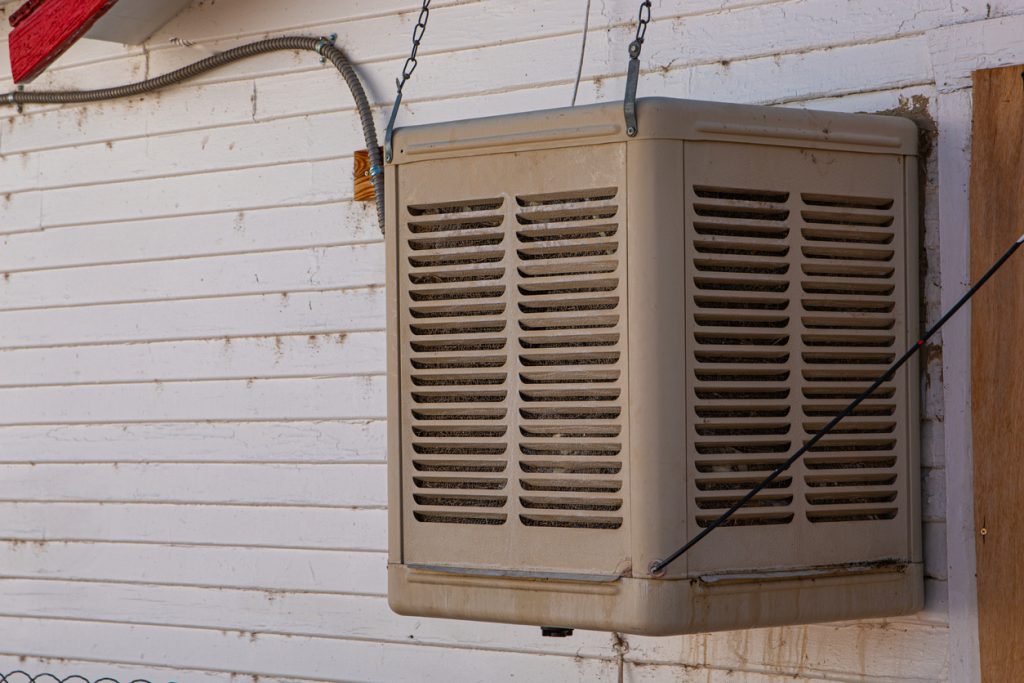
- Visible rust, corrosion, or wear on the unit itself
- Difficulty sourcing replacement parts for an older model
Any one of these on its own isn’t necessarily a reason to replace immediately, but a combination of several is usually a strong signal that replacement is worth considering sooner rather than later.
Get an Honest Assessment Before You Decide
Deciding between a repair and a full replacement comes down to the system’s age, the specific fault, and how the numbers stack up against a new installation. A proper assessment makes that decision a lot clearer than guessing based on age alone.
Get in touch with our team or call 1300 164 217 for an honest opinion on whether your system is worth repairing.